

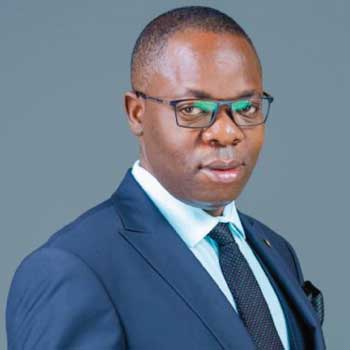
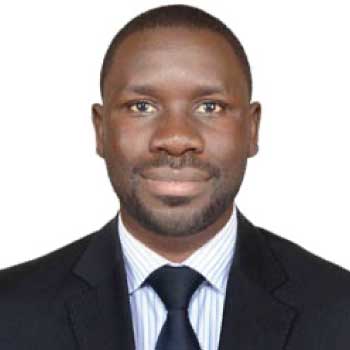



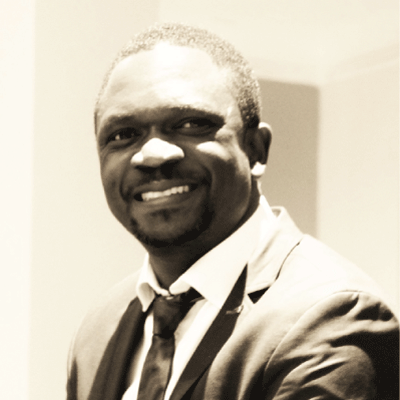


Prof. Benjamin Kumwenda is an Associate Professor of Bioinformatics & Computational Biology at the Kamuzu University of Health Sciences in Malawi. He is the research lead for Bioinformatics and Computational Biology at the University. His research interests are in comparative genomics, bacterial pathogenesis, transcriptomics, next generation sequencing (NGS) and protein modelling. He works on the pathogenesis of Salmonella to understand drug resistance mechanisms using NGS, transcriptomics and protein modelling techniques. He has worked extensively on the Next Generation Sequencing of viral genomes particularly Rotavirus and SARS-CoV-2.
Benjamin Kumwenda holds a BSc Degree in Computer Science from University of Malawi, Chancellor College; a Postgraduate Diploma, Honors and an MSc Degree in Computer Science from the University of the Witwatersrand, Johannesburg, South Africa. He obtained a PhD in Bioinformatics from the University of Pretoria, South Africa in April 2014. He has done Postdoctoral Research Fellowships with the Malawi-Liverpool Wellcome Trust under the H3Africa Bioinformatics Network (H3BioNet). In 2016 he was awarded the prestigious MRC African Research Excellence Fund (AREF) Postdoctoral Fellowship. He is also an awardee of the RISE Graduate Competitive Fund. In 2018, he was awarded the three-years AESA-RISE Postdoctoral Fellowship.
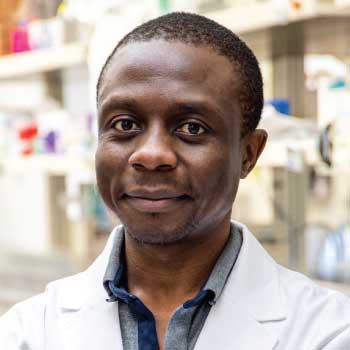
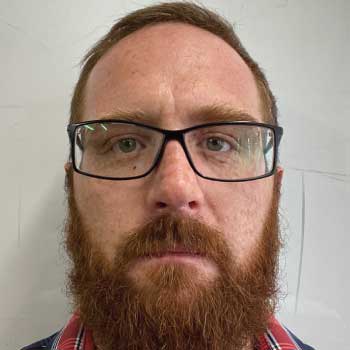
Dr. Yinda has a Bachelors and Masters degree in Biochemistry from the University of Buea, Cameroon. He obtained his PhD in Viral Metagenomics from the Katholieke Universiteit Leuven, Belgium. Currently, he is a Research Fellow at the Virus Ecology Section of the Rocky Mountains Laboratories, National Institute of Allergy and Infectious Diseases, National Institutes of Health. He uses metagenomics and bioinformatics approaches to identify novel infectious diseases agents, and evaluation of the cross-species transmission, pathogenesis, and outbreak potential of newly identified infectious agents. Over the years Dr. Yinda has developed expertise in next generation sequencing (NGS) and quantitative virome analysis, which have earned him over 45 peer reviewed papers in highly ranked journals such as Nature, Nature Communications, eLife, PLoS Pathogens, and Emerging Infectious Diseases.
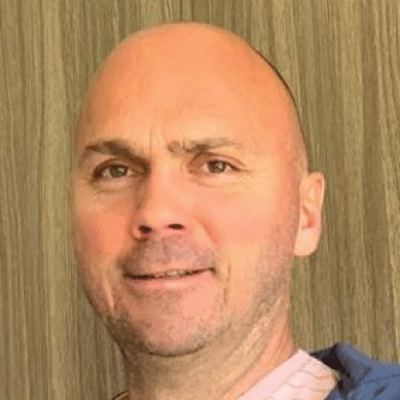
Dr. San is a bioinformatician, molecular biologist and data scientist with specialist expertise in genomics, phylogenetics, statistical genetics and software development. He is currently a postdoctoral researcher at the University of KwaZulu Natal, Durban, South Africa at the KwaZulu Natal Research and Innovation Sequencing Platform (KRISP). He holds a PhD in Medicine and research experience in infectious diseases with a strong track record of combining molecular epidemiology with statistical analysis of pathogen genomic variation and the development of bioinformatics software. He is a member of several professional research bodies and collaborations including the Network for Genomic Surveillance in South Africa (NGS-SA), The Public Health Alliance for Genomic for Genomic Epidemiology (PHA4GE), Africa COVID-19 Genomics consortium, Climate Amplified Diseases and Epidemics (CLIMADE) consortium, Africa Centers for Disease Control and Prevention (CDC) Pathogen Genome Initiative (PGI) Vaccine Preventable Diseases Focus Group (VPD FG), Phylogenetic Analysis for Generalized Epidemics in Africa (PANGEA_HIV) consortium and a fellow of the H3Africa Bioinformatics Network (H3ABionet). Dr. San has published over 40 manuscripts in high-ranking international journals (including Nature, Science, The Lancet, Lancet Infectious Diseases). His work has been cited over 7,000 times. He has an H-index of over 30. His current research interests include the use of phylogenetic models to understand the drivers of infection transmission of SARS-CoV-2, HIV, TB, Arboviruses and vaccine preventable diseases in Africa. He is also interested in the microbiome, transcriptomics and metagenomics to characterize niche viral and bacterial communities and to investigate their impact on host responses and response to treatment.
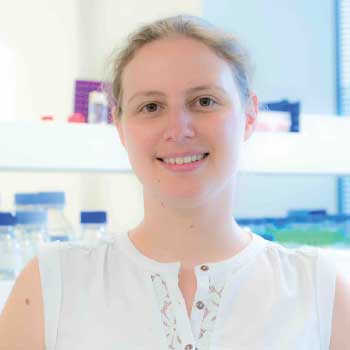
Dr. Stephanie van Wyk is a research scientist with more than 12 years of research experience in bioinformatics, biochemistry, and genetics. She is based at Stellenbosch University and serves as a bioinformatics researcher at the Centre for Epidemic Response and Innovation (CERI). Here, she generates Next Generation Sequence (NGS) data to support pandemic mitigation, not only locally but across Africa. The work at CERI on molecular epidemiology remained a cornerstone to facilitate timely intervention responses during the COVID-19 pandemic.
She is equally experienced in laboratory and bioinformatic environments, but her true passion lies in comparative genomics. Throughout her postgraduate and postdoctoral career, she served as a supervisor, laboratory manager, and training officer, mentoring a range of audiences. She represents her institute on research committees and forums such as the Africa CDC, the NGS-BRICS consortium (NGS Brazil, Russia, India, China, South Africa) and NGS-South Africa. She is passionate about Python and has strong experience working in Linux environments.
During her years of working as a bioinformatic scientist, she has gained valuable experience in genome assembly, quality control, and working on the evolution of complex traits and phenotypes. A quote from one of her favourite evolutionary biologists John Taylor states: “Genetic variation is the stuff of evolution”. Indeed, investigating the evolutionary potential introduced by large- and small-scale genetic alterations has been the focus of her postgraduate studies that she completed at the Forestry and Agricultural Biotechnology Institute (FABI), at the University of Pretoria. Here, she worked on the magical world of fungal genetics investigating the gain and losses of entire chromosomes, adaptations that resulted from horizontal gene transfer and the manner the accumulation of mutations can drive species divergence and alter host-pathogen interactions.
Prof. Saheed Sabiu is an Associate Professor at the Durban University of Technology, where he leads the Computational and Systems Biology Research Group. The Group bioprospects for secondary metabolites against degenerative and microbial diseases for new small molecule targets discovery. He is also interested in the molecular dynamics of enteric and respiratory viruses using whole-genome sequencing, in silico and metagenomic approaches. He has mentored several postgraduate students and his research has attracted funding from the National Research Foundation (NRF), Technology Innovation Agency (TIA) and the South African Medical Research Council (SAMRC). Besides holding the NRF Y-rating as an emerging researcher, Prof. Sabiu is a Fellow of the Future Professors Program of the South African Department of Higher Education and Training (DHET) and a member of the Africa Centres for Disease Control and Prevention (CDC) Focus Group on Vaccine Preventable Diseases (VPD).
Prof. Errol Duncan Cason is an Associate Professor in the Department of Animal Sciences at the University of the Free State, and his research is focused on quantitative animal breeding. Animal breeding encompasses various aspects of bioinformatics such as genomics studies, variant calling, genomic breeding values, genome wide association studies, among others. In addition, he has a broad background in microbial diversity in niche environments, or biomes and has incorporated this into his animal science research by investigating diversity shifts in rumen biomes due to various treatments. He has also an interest in heritability of rumen biomes and their correlation to production traits in animals. His research publications can be accessed here:
https://scholar.google.com/citations?user=V3fpZ3YAAAAJ&hl=en
His selected presented training include:
16S metagenomics data analysis in Qiime and R. Postgraduate course. University of the Free State (2018-Present).
Introduction to Bioinformatics (IBT). H3ABionet Course. University of the Free State (2019).
Dr. Celeste Donato holds joint Senior Research Fellow positions in the Enteric Diseases research group at the Murdoch Children’s Research Institute, and at the Australian Pathogen Genomics Program at The Peter Doherty Institute for Infection and Immunity. She is also an Honorary Fellow in the Department of Paediatrics at the University of Melbourne as well as an Adjunct Research Fellow and Lecturer in the Department of Microbiology at Monash University.
Dr. Donato is a virologist known for her expertise in rotavirus epidemiology and evolution. In addition to rotavirus, she has extensive experience in RSV, norovirus, enterovirus, astrovirus and influenza research.
Celeste completed her PhD in the Enteric Diseases Group at the Murdoch Children’s Research Institute and Department of Microbiology at La Trobe University in 2015. Her project focussed on the impact of rotavirus vaccine introduction on the diversity and evolution of rotavirus strains in Australia. She then completed a two-year postdoctoral position at Duke-NUS Medical School in Singapore, where she characterised outbreaks of viral infections in several countries within Southeast Asia. Celeste was awarded a prestigious NHMRC Peter Doherty Biomedical Fellowship and joined the Laboratory of Virus Evolution in the Department of Microbiology at Monash University in late 2016. In 2019 Celeste re-joined the Enteric Diseases Group the Murdoch Children’s Research Institute as a Senior Research Officer. She currently leads the genomic characterisation of rotavirus strains within the Australian Rotavirus Surveillance Program and the microbiome and virome exploratory studies within the RV3-BB vaccine clinical trial.
Dr. Donato has extensive laboratory expertise in rotavirus genotyping, full genome sequencing, and NGS methodologies. Dr. Donato is an expert in generation and curation of large genomic datasets, in particular alignments of large, complex genomes of viruses that undergo genomic recombination. She is also an expert in generating and interpreting phylogenetics trees using a variety of programs and Bayesian methods for evolutionary analysis.

Armand is a dedicated biochemist/virologist with expertise in molecular biology and bioinformatics. In 2011, Armand took on the role of Assistant Researcher, focusing on the development and application of an HIV resistance genotyping assay. He was responsible for data analysis and the management of collected genotypes and clinical information. Since 2015, he has been working as a Medical Scientist in Virology at NHLS Universitas in Bloemfontein. In this position, Armand’s responsibilities include conducting virology research, overseeing testing procedures, and ensuring quality control. He has also contributed to next-generation sequencing and surveillance of SARS-CoV-2 genomes, aiding in sample selection, bioinformatics analysis, and genome consensus generation.
Throughout his career, Armand has made significant contributions to the field of virology. He has developed an HIV drug resistance assay and played a crucial role in its validation, ensuring its accuracy and precision. He is an active member of the national NHLS HIV drug resistance subcommittee, contributing to discussions on operational aspects, quality assurance, clinical applications, and research related to HIV drug resistance. Armand’s expertise and dedication have led to the accreditation of the assay and its integration into the NHLS facilities.
Furthermore, Armand has excelled in the area of bioinformatics and data analysis. He has developed a phylogenetic pipeline for HIV drug resistance testing and published his work in PLOS ONE. This pipeline has become an essential part of quality control in drug resistance testing facilities. Armand has also demonstrated his proficiency in programming languages such as Python and R, utilizing them for statistical analysis, creating evaluation reports, and solving real-world problems.
As an avid learner, Armand constantly strives to improve his coding abilities and statistical knowledge. He actively engages in online training courses and utilizes platforms like Udemy and freeCodeCamp to enhance his skills.

Dr. Karla Stucker is a teacher, veterinarian, and virologist. She studied cellular and molecular biology as an undergraduate at Cornell University’s College of Agriculture and Life Sciences. She then joined the inaugural class for Cornell’s College of Veterinary Medicine’s combined DVM/PhD program. During her combined degree training, Karla pursued a mixed small and large animal pathway during her clinical rotations, completed a dissertation on the evolution of canine parvovirus, and developed her pedagogical skills as a future faculty fellow. After earning her veterinary degree, Karla worked part time for Shelter Outreach Services in Ithaca, New York, providing spay/neuter surgeries and infection control support for regional animal shelters. After earning her PhD, Karla completed her postdoctoral studies at the J. Craig Venter Institute in Rockville, Maryland, where she continued studying viral evolution and host switching, as well as genomics, bioinformatics, and microbiome sciences.
Driven in part by the need to get students interested earlier in biomedical and health sciences and her love for teaching, Karla chose to move from higher education to secondary school education. She was a science teacher and dorm parent at George School, a Quaker boarding and day high school in Newtown, Pennsylvania, for five years before joining the Waterford School faculty in Sandy, Utah, where she currently teaches science to middle and high school students. Karla also works as a part time small animal veterinarian at Salt Lake Veterinary Service in Taylorsville, Utah.
In addition to teaching and practicing veterinary medicine, Karla enjoys spending time with her dogs, Fig and Fern, Nordic skiing, hiking, reading, and solving puzzles. She is excited to work with the participants and facilitators of the 2023 Bioinformatics Workshop!

Prof. Arox Kamng’ona earned his PhD in Infection and Immunity from the University of Liverpool in the United Kingdom. He is an Associate Professor of Molecular Biology at Kamuzu University of Health Sciences (formerly the University of Malawi, College of Medicine) and an Honorary Fellow at the Institute of Infection and Global Health at the University of Liverpool. He currently serves as the Executive Dean for the School of Life Sciences and Allied Health Professions. His research focuses on human microbiomes and their effect on human health and disease in resource-limited African settings, particularly in the context of nutrition and diarrhoea infection. His ORCID ID is 0000-0002-0841-7586

Ms Precious Letebele is a Lecturer in the Department of Microbiology and Biochemistry at the University of the Free State, South Africa. She holds a Master’s degree in Biochemistry and is pursuing a PhD in Biochemistry. Her current research involves investigating the role of yeast lipid metabolism in the pathogenesis of the fungal pathogen Candida albicans. She explores the pathogenesis of the fungal yeast candida albicans by investigating the transcriptome, proteome, and metabolome of this yeast, where she employs bioinformatics techniques. Her future research interests lie in drug development to combat anti-microbial resistance.
Fanie Riekert is an Assistant Director at the University of the Free State in Bloemfontein, South Africa. He is one of the High-Performance Computing unit’s staff at the University. He provides eResearch support to the university’s research community by deploying software to the cluster, writing scripts to help with analysis, and transferring skills by means of user training. He currently focusses on deploying software via Apptainer containers and using existing Docker containers, and investigating the use of scientific workflow management tools, specifically Nextflow. Fanie Riekert holds a B. Sc. Hons in IT and a B. Sc. Hons. in Mathematics from the University of the Free State.
Prof Jason M. Mwenda is currently the Regional Co-ordinator responsible for co-ordinating surveillance for Vaccine Preventable Diseases in the WHO Region Office for Africa (WHO/AFRO), Brazzaville, Republic of Congo. As part of his responsibilities, he co-ordinates among others hospital-based surveillance for diarrheal diseases, invasive pneumococcal diseases (IPD) and provides guidance to countries in the African Region to use evidence to support decision-making on new vaccines introduction and monitoring impact of new vaccines including rotavirus vaccines, PCV and COVID-19 vaccines.
These activities involve working closely with national Governments and key immunization partners to support introduction of new vaccines into national routine immunization programs. These efforts have resulted in 40 out of 47 countries in the WHO African Region introducing PCV in the national immunization programs, while 38 out of 47 countries in WHO/AFRO have introduced rotavirus vaccines.
A number of these countries are now using established regional sentinel hospital-based surveillance system to evaluate the impact of rotavirus vaccines and also PCV on meningitis and pneumonia hospitalizations including the safety signals during the malaria vaccine implementation project (MVIP).
He has published 274 scientific publications in peer international peer reviewed journals, contributed to several book chapters, has been guest editor for several journals. He has co-ordinated publication of six special journal supplements on Rotavirus disease burden and impact of rotavirus and pneumococci conjugate Vaccines (PCV) vaccination in Africa including a journal supplement “Early Impact of pneumococci conjugate Vaccines (PCV) in Africa, Clinical Infectious Diseases (CID), 15 September 2019.
Prof Mwenda is currently co-ordinating monitoring of vaccine effectiveness (AFRO-MoVE), recently established network comprising of 19 countries conducting COVID-19 vaccine effectiveness (VE) studies and genomic surveillance for SARS-CoV-2 variants as part of COVID-19 pandemic response.
Prof Mwenda was awarded Ph.D. (Immunology and Virology) degree by the Faculty of Medicine, University of Liverpool, UK in 1993. He has been awarded several honors and awards in recognition of his immense contribution to health research and development and capacity building activities including public health research, training and teaching and mentoring young scientists with a focus prevention and control of infectious diseases in Africa. He also has mentored and supervised many cadres of postgraduates including PhDs, post-doctoral students and facilitating international students exchange.
Prior to joining WHO Prof Mwenda was involved in health research for over 25 years, has worked in various capacities and leading various institutions in different countries including Kenya, UK, Japan, Italy and USA in the area of vaccine research and development, immunogenetics, control and prevention of infectious diseases.
Prof Mwenda has undertaken many strategic and change management courses and serves in various international advisory bodies and provides technical and policy guidance on vaccine implementation and policy, strategic development and management of health research globally and working with development partners, national governments and institutions in the African Region.
Dr. Shane Murray is a highly accomplished professional in the field of plant molecular biology and genomics. She holds a PhD in Molecular Plant Sciences from the Institute of Molecular Plant Sciences at the University of Edinburgh (2001). Prior to that, she completed an MSc cum laude in Plant Molecular Biology at the University of KwaZulu-Natal, Pietermaritzburg (1996), a BSc (Hons) cum laude in Plant Molecular Biology at the University of KwaZulu-Natal (1993), and a BSc with majors in Genetics and Plant Molecular Biology, with a distinction in Plant Molecular Biology, from the University of KwaZulu-Natal (1992).
Dr. Murray’s employment history showcases her extensive experience and expertise. She currently serves as the Genomics Coordinator and Domain Expert at DIPLOMICS since June 2021. Prior to this, she worked as a Senior Genomics Project Manager at the Centre for Proteomic and Genomic Research (CPGR) from January 2017 to May 2021. From January 2017 to December 2019, she held the position of Honorary Research Associate in the Department of Molecular and Cell Biology (MCB) at the University of Cape Town (UCT). Before that, she was a Lecturer in the Department of Molecular and Cell Biology (MCB) at UCT and concurrently worked as a part-time Agrigenomics Project Manager at CPGR from October 2011 to December 2016.
Dr. Murray’s previous roles also include serving as a Project Scientist at CPGR from January 2007 to September 2011, working as a part-time Lecturer in the Biotechnology Department at the University of the Western Cape in 2006, and holding a Post-Doctoral Fellowship in the Department of Molecular and Cell Biology at UCT from 2001 to 2006. She commenced her research career as a PhD candidate at the University of Edinburgh from 1997 to 2001. Prior to that, she worked as a Researcher at the Biotechnology Division of the ARC-Roodeplaat Vegetable and Ornamental Plant Institute, Agricultural Research Council, Pretoria, from 1993 to 1997.
Dr. Murray’s impressive educational background, combined with her significant contributions and roles in various research institutions, exemplify her dedication to advancing the field of plant molecular biology and genomics. Currently serving as the Genomics Coordinator and Domain Expert at DIPLOMICS, Dr. Murray continues to be at the forefront of scientific innovation and is driven by her passion for furthering advancements in her field.