

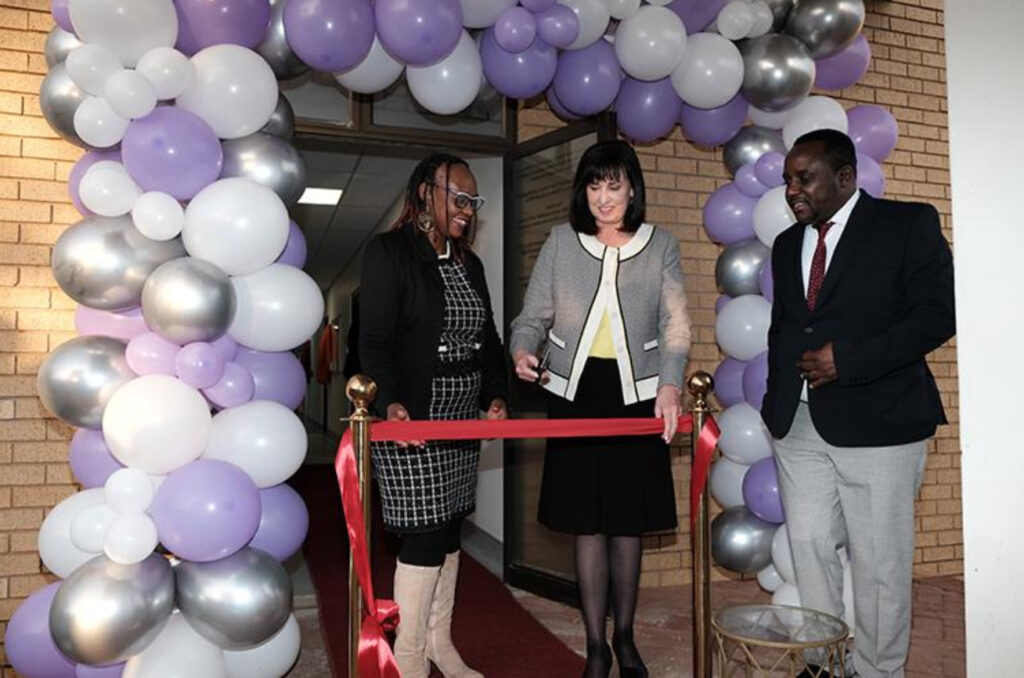
Chancellor and Principal, and Prof Martin Nyaga, UFS-NGS head, cutting the ribbon to launch the Next-Generation Sequencing (UFS-NGS) Unit upgraded facility.
The University of the Free State (UFS) Next-Generation Sequencing (UFS-NGS) Unit on Tuesday (26 May
2026) not only launched its upgraded facility but also celebrated its 10th anniversary. On the same
night, the unit also celebrated being designated a UFS Sustainability Research Chair.
The evening was attended by Prof Hester C. Klopper, UFS Vice-Chancellor and Principal; Dr Molapo
Qhobela, Deputy Vice-Chancellor: Strategic Initiatives, International and Institutional Affairs; Prof Deliwe
Phetlhu, Dean for the Faculty of Health Sciences, as well as other staff from the faculty and partners. The
evening started with a ribbon-cutting and tour of the new facility.
In her keynote address, Prof Klopper said everyone was there for three things: to acknowledge the work
of the past 10 years, to launch and celebrate the University’s recognition of Prof Martin Nyaga, UFS-
NGS head, and the unit as a designated research chair, and lastly to launch the new facility. The UFS-
NGS Unit is now home to the Research Chair in Genomic Surveillance of Respiratory and Enteric
Pathogens from Children in South Africa.
Make no little plans
“When we look at where the University finds itself in terms of our vision of being a research-led,
innovative university, student-centred and regionally engaged towards a responsible societal future,
that’s the essence that I see in this unit,” said Prof Klopper.
“People are most important. To make anything work, you need excellent and committed staff, and you
need committed students. Let me recognise and congratulate Prof Nyaga on being a champion.
Ultimately, if you want anything to work, you need a champion. I want to make this a centre of excellence.
We are committed to growing the people and the human resources.”
Prof Klopper said she recognised that to make the place a world-class facility, there needed to be
investment in the equipment it uses. There is also a need for a commitment to grow the post-graduate
programmes in terms of the master’s programme, leading to a PhD.
Quoting from a book by Daniel Burnham, Prof Klopper said her mission for the faculty and the unit is to
“make no little plans because they stir no man’s blood”. Go big.
Contribute to solving Africa’s problems
Prof Nyaga called the launch of this new facility very special. He gave an overview of the unit’s work
over the past 10 years, saying it was started because the University wanted to contribute to solving
Africa’s problems.
“At the time, Africa faced a shortage of genomics capacity. Genomic science was also limited at the
time. Today, the unit is a sequencing laboratory for the African Enteric Viruses Genome Initiative (AEVGI).
We are part of a genomic surveillance network in South Africa, which plays a crucial role in discovering
and informing government policies,” he said.
“We have written policy briefs for governments, including a brief for Cholerae variants in Malawi, as
well as for the COVID-19 pandemic.”
Prof Nyaga talked about the unit’s passions, which include the research, training and workshops, the
postgraduate programme, as well as the outreach programme for school learners. “We are ready for
the future. We want to bridge the genomic gaps and advance viral signs, grow more continental
partnerships and to train and influence policy,” he declared.
A beacon of research excellence
According to Prof Phetlhu, these celebrations are not merely ceremonial achievements. They are
declarations of intent – the UFS is no longer a consumer of high-end genomics, but a producer, a trainer,
and a partner in the global genomic enterprise.
“With the official opening of this expanded NGS facility, we are embedding next-generation
sequencing into the very architecture of health science research at UFS. This unit is marked by what it
truly stands for: rigour, training, and public health impact.
“This unit is anchored in responsibility. Its work will directly inform vaccine policy for respiratory and
enteric pathogens affecting children. As a Dean, this is what I will support without hesitation: impact
because the impact is measurable, translational, and lifesaving,” said Prof Phetlhu.
The UFS-NGS Unit, she continued, has rapidly become one of the beacons of research excellence within
the Faculty of Health Sciences and across the entire University. Over the past decade, the UFS-NGS Unit
has trained more than 40 postgraduate students, including interns and postdoctoral fellows, many
graduating with distinction. This year, the unit added eight new MSc and PhD students and postdoctoral
fellows under a new research chair.
The unit has produced over 80 peer-reviewed publications in high-impact journals, including contributions
in Science, Nature, and Nature Medicine. As a WHO Collaborating Centre, the unit continues to support
vaccine-preventable disease surveillance across Africa while leading groundbreaking projects on
antimicrobial resistance and pathogen evolution.
“As Dean, I commit to supporting the investment in personnel, starting with postdoctoral fellows, because
data without analysis is noise. I also commit to advocacy for recurrent operational funding, because
although you have been able to raise much, it is still the responsibility of the University, particularly when
circumstances are beyond your control,” she told Prof Nyaga.
The UFS-NGS Unit exemplifies what is meant by research that is relevant, excellent, and impactful. It
perfectly aligns with the faculty’s vision of producing world-class graduates and generating knowledge
that serves communities, and the University’s mandate to contribute towards responsible societal futures.
The future being built is bright
Dr Dee Jordan, a health geographer and environmental science researcher at Harvard Medical School
in the Department of Global Health and Social Medicine in the US, said it is not simply the 10th
anniversary and opening of a laboratory. It is the opening of possibilities.
“Walking through the NGS facility – seeing the sequencing capacity, the laboratory infrastructure, the
collaborative spaces for students, interns, staff, and postdoctoral researchers – I was struck by something
immediately: this facility rivals spaces I have worked in at the Broad Institute of MIT and Harvard.
“That matters. Because scientific excellence does not belong to one country, one institution, or one
continent. The future of genomics and disease surveillance will depend on global collaboration and
globally distributed scientific leadership,” said Dr Jordan.
According to her, the UFS-NGS Unit is evidence that the UFS is positioning itself as part of that future.
Beyond the grants, the technology, and the science, she said, what matters most is what this space
represents for students and young scientists. The future being built at the unit is bright.
By Andre Damons